Showing posts with label blinding you with science. Show all posts

Monday, May 23, 2011

Tastes (Kinda) Like Chicken, Looks Like The Lower 48?

Call me old-fashioned, but I like my food to look like food.  Sure, it's a well-known fact that I enjoy the little cheese crackers with the peanut butter in them, and that color does not occur in nature except to scream 'poisonous!', but they do look exactly like they're designed to.

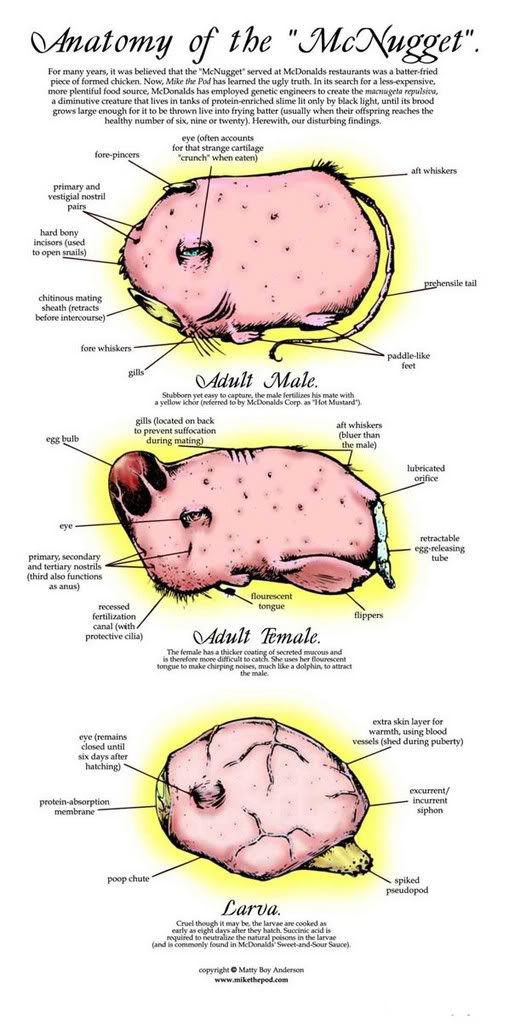
On the opposite side of the coin, what's the deal with chicken nuggets?  First it was McDonalds, and now it seems everyone is jumping on the 'that's-not-shaped-like-food' bandwagon.  I don't eat McNuggets, but on occasion, nuggets from other fast food icons make a quick and tidy snack when I'm on the run, and they're all shaped the same. Some of them look like Minnesota.  Some of them are shaped like animators used to draw pork chops back in the 1940's.  Some of them are shaped like paramecia.  Some of them have no rhyme or reason whatsoever, and they're only benefit is the ability to fit neatly into a vat of barbecue or sweet-and-sour.

I get the dinosaurs, the stars and the other amusing kid-friendly shapes, because we want our kids to eat something besides paste and scabs.  But unless you come out with the full fifty state nugget pack to teach them geography, it seems wrong to pick on one or two.  And 50 nuggets would just add to the growing childhood obesity issues in this country, especially dipped in honey mustard.

Round is good.  Shape them like drumsticks, I'll be happy.  It's an extrusion, you can't tell me these are the only shapes we can come up with.
Does that look like a McNugget/New Hampshire to you?
I mentioned my curiousity about this to someone the other day, and they sent me to this article about genetically engineered ground meat.  That's right, scientists are developing cell structures that will grow a hamburger without ever needing to be farm-raised, slaughtered or butchered, and it won't create the mass amounts of greenhouse gas expelled by real cows and chickens. 

This makes perfect sense to me, that half of the meat we consume is already ground, so why not remove the animal cruelty from the picture?  I love the American farm and the American farmer, but I've read much on the environmental impact a single cow can have on global warming, and how each cow produces 1/16th the meat-to-pollution ratio of smaller animals like chickens.  And now, everyone could grow their own meat.  I'm on board.

The only tragedy here?  Every day I don't finish my old novel is a day that my imaginary happenings become closer to truth.

Damn.  I wish I had some of those cheesy peanut butter crackers.

Monday, May 9, 2011

Blast from the Past - The Other Organ Donor

Times continue to be busy around here at CDS Enterprises (A wholly-owned division of NFG Worldwide, Ltd.) and despite recent posts, I still feel compelled to share past musings and crotchety posts from the ether.

In light of my repeated musings on the subject of pork and pork products, I thought I'd share this little gem with you from May '07. 

I've been thinking about the news stories reported below HERE and HERE and the possible implications for the last few weeks, since it ran on our local news (actually, we just looked it up on the station's website, since I can't sit through 58 minutes of human interest drivel just to get to the one potentially significant news story of the evening…). I've had diabetic family members, as has Lori. Our friend was just diagnosed at age 35. One of my clients is active in the state's chapter of the ADA, and we've ridden in the 'Ride for the Cure' pledge drive. However, it doesn't mean I knew anything about the disease, and especially that 20 million people in the US alone are afflicted with it. I can't even imagine 20 Milwaukee-sized cities full of people (or, as it turns out, 20 Cleveland-sized cities). In a world of 6.7 billion people, and even in a nation of over 300 million, the number suddenly seems insignificant. (Actually, the US Census Bureau projects that the US gains one person every 11 seconds, between births, deaths, and immigration, and our planet gains approximately 60 million people each year.)


The medical community has been breeding immunosuppressant swine for years now, to develop xenotransplantation-safe organs since we're wearing ours out faster than we can donate them. For my further thoughts on organ donation, click here.
I may be a selfish bastard, but if we keep curing diseases and cleaning up pollution and driving smaller cars and buying organic vegetables, how long will it be before we've outgrown the planet? Surely a topic for another blog entry would be the exponential loss of farmland in our nation to housing developments, and at the same time the fact that we produce more food on fewer acres thanks again to the scientific community. But that is, in fact, a topic for another blog so that's all I'll say here.

Yes, this is a disjointed commentary, because I have so many unanswered questions. Anyone who knows me understands that this is how my brain works. So, without further ado or segue, what do they do with the pigs once they've donated their bodies to science? If the islet cells are taken from the pigs, do the pigs become diabetic, or can their bodies manufacture more? If the pigs give their lives for this process, does the research lab at least have a nice pig roast the following weekend? I can't imagine such a waste of resources if the resultant meat (as long as it remains immunosuppressantly delicious) were just thrown away, instead of being consumed. Unless, of course, once you've received porcine cells, that eating a pork chop would be tantamount to cannibalism. And what about the Muslim and Semitic populations of the world? Religious dogma for these groups dictates the consumption of pork is taboo, what does it say about having the swine's cellular makeup inserted into the very makeup of our genetic profile?

Like I said, I have so many unanswered questions. And now I'm hungry, too.

Friday, April 8, 2011

Fun Fact Friday - Bilirubin the Kid

As I may have mentioned, I recently became both a grampa and an uncle.  This leads to all sorts of additions to my vocabulary, including terms that should never be used in polite company (i.e. mucus plug).

Grace, my niece, spent an extra day in the hospital when they couldn't find a bilirubin blanket.  Apparently, those things are a hot commodity.  Jordan's bilirubin levels climbed once he was home, but both wee little childrens are healthy now.

Jaundice is caused by a processing inbalance.  Bilirubin (the artist formerly known as hematoidin) is a naturally occuring product of the body, created when red blood cells break down.  Because babies produce red blood cells at a quicker rate than adults, they produce a higher bilirubin-to-weight ratio than adults.  Bilirubin is processed through the liver, and eventually gets pooped out.  (Not tired, but excreted.  Don't you love the ambiguity of the English language?)

Babies can't always process bilirubin efficiently, because their livers haven't developed completely (in the case of premature birth), or because they don't manage to poop efficiently. 

In more serious cases, jaundice can be caused by an infection, or by other disorders of the thyroid.  It's also possible when a newborn doesn't get enough breast milk, or, in the case of an Rh-factor mismatch, when a mother's milk actually creates antibodies that damage the child's red blood cells.

So maybe this isn't a 'fun' fact, but it is a common occurence, and when treated properly, children can come through it without any permanent damage.

As for permanent damage, however, I'm not sure which is worse: me EVER hearing the words 'mucus plug' (DON'T Google it.  No good can come of that) or my brother-in-law inadvertently seeing the placenta drop.

Update - As Frank was so kind to point out, I never talked about how the Biliblanket works. Imagine TRON. UV light can be used to convert the subcutaneous bilirubin to other byproducts that break down and metabolize without the help of the liver. While looking like Flynn or Yori.

I always wanted one of those light cycles.

Friday, September 17, 2010

Fun Fact Friday - NFG's In Cleveland Without the Vitamin D

I have a couple of couches, and as a matter of fact, have been known to fall asleep on the loveseat on more than one occasion.

It turns out I have a vitamin D deficiency.  One would find that hard to believe, me, not getting enough dairy?  However, it would seem that adult vitamin D deficiency is relatively common in shut-ins and the institutionalized.  And if you don't think working in an office all day is the same as being institutionalized, you need to wake up and smell the soothing green walls. 

I'm not getting enough sun, eating enough fish or liver, and I apparently need to up my dairy intake.  And apparently as we age, and because the American Cancer Society along with the National Sunscreen Coalition have been harping at us about UV rays, wearing sunscreen actually inhibits the body's natural ability to synthesize Vitamin D.

(I'm already sick of typing 'Vitamin D' but somehow abbreviating it as 'VD' might give readers the wrong idea...)

Vitamin D deficiency can prevent your body from absorbing calcium (hypocalcemia) and potassium from the foods you eat, meaning your body will start stealing those minerals from itself.  I can end up with osteomalacia, or 'adult rickets'.  With my BMI, I don't think brittle bones are a good thing.  Apparently, it could also be driving my RLS.  See?  I'm not kicking Lori in her sleep due to suppressed rage, after all.  Proper vitamin D levels could also help prevent certain cancers.

So what then, is an appropriate level of solublized Vitamin D?  From the office of 'Well, duuuuuuh!', the Vitamin D Council suggests that the minimum level is 2 1/2 times that which was recommended by the doctor's office.  I don't know what my hypochondria is going to do with this conflicting data.

All I know is that I've had it up to here with these damn rickets.

Thursday, August 26, 2010

Random Acts of Thursday - Elementary, my dear Watson!

I've been remiss.

Several weeks ago, I waxed (on, wax off) about the chronological advance of my childhood crushes.  Somehow, I neglected to include Jodie Foster on that list.  Also in that episode, despite mentioning Phoebe Cates, I failed to post the quintessence of Phoebiness, her Fast Times bikini shot.

I'm here to rectify that.
I've also been lacking in the movie and music trivia department of late. 

I'm here to rectify that.


Wait, this doesn't cut it?  Fine, then.

Something that bothers me regularly, if you'll forgive the lack of segue, is our nation's need to endlessly remake films.  Sure, there are some original ideas out there, but really, did The Karate Kid cry out for a Jackie Chan remake?  Pat Morita must be rolling over in his grave.  (Wait...is Pat Morita dead?  I should probably check that out...)  And if they're not remakes of old movies, old TV shows, or bad Saturday morning cartoons, they're sequels, which I always assume are bad.  Saves me going to the movies, my couch is far more comfortable.

It's as though we can't come up with original ideas.  I have lots of original ideas, myself, but few of them ever see completion.  I'm recruiting, Crappy Unfinished Novel Time needs more creative input.  I'll keep posting my stuff, but really, anyone is welcome to contribute, free of charge.

I'm also soliciting for reader input here at the CDS.  Email me your questions, however trivial or inane.  It's called filler, people!

Also, while I've not been writing many posts lately, the larger crime is that I haven't been reading many other blogs, either.  And commenting on fewer.  I apologize to the many talented and creative writers who bless the Internet with their work.

But finally, it's quiz time!  I'll bet you thought it would never happen.
Every time it's shown on television, I get sucked into The Fifth Element.  (Happened again last Friday, when I picked up the last ten minutes.)  Besson's editing is quick and I love every minute of it.  Milla Jovovich isn't bad, either.  As far as current science is concerned, there is no 'fifth element'.  However, there are four other elements, earth, water, air and fire, that deserve equal billing. 

Therefore, onto the quiz.

1)  Name three songs (along with the performing artist) that mention earth (or some variation on the theme) in lyrics. 

2)  Ditto for fire.

3)  Ditto for air.

4)  See where we're going with this?  List three songs that mention water in some form.

5)  A question for Bob, name a song that mentions water in addition to my favorite dessert.

6)  Name five bands that reference one of the four elements in their band name.

7)  Name two bands that reference, rather than one of these elements, an element from the periodic table, as their name.

8)  Identify the band whose song about an airborne conveyance, while lyrically not qualified for an answer above, uses two elements to achieve lift.

9)  Name the author and 1962 book whose central premise is the same as the name of that band.

10)  Finally, which band released an album by the same name as the band from question 8 (mysteriously close to the time the band in question 8 took their name)?

As always, we grade on a curve here at the great and powerful CDS.  Show your work, kids!

And with special thanks to Dave Barry (along with Strunk and White) as an early influence on my sensibilities, 'Elements of Style' would be a great name for a band.  Just sayin.

Friday, April 2, 2010

Fun Fact Friday - It's not easy being green

I've never shied away from planting trees.  In third grade, we were sent home with elm seeds, a new variety reportedly resistant to Dutch Elm disease.  That little seed grew to a massive 30 feet or more by the time I saw it last, probably ten years ago.  

A few years ago, I started taking an interest in bonsai, the Japanese art of miniature trees.  I haven't found the appropriate outlet for this interest, never found the group here in Tampa.  Killed my first tree, but that doesn't mean I won't try again once we move next.  We planted a Japanese maple at the corner of our home in Wisconsin, and it's still strangely exciting to drive by and see how it's doing.

I saw a headstone in North Carolina a while back that had a beautiful Japanese maple growing from it, maintained lovingly by someone to keep it in perfect scale with the planter built into the stone.  I would love such a thing, if that isn't too morbid.

We were cleaning out the flower beds and continuing our mulching efforts last weekend, and I noticed a foot-high oak sapling, just taking root perfectly in the corner of the yard.  Away from mowers, perfectly spaced where it could be a feature, I can only hope the next owners decide, as I did, to leave it be. 

The next step, of course, is arborsculpture.  Rather than emphasizing the natural form, trees are made to do unthinkable contortive feats, to great effect.  I've seen some works of this in the past, gazebos made entirely of living things, and I love whimsy in the garden.  These are some cool pieces, and some things I hope to mimic the next time we have a permanent garden of our own.

However, planting trees has become more politicized in my lifetime.  Growing up exploring the forests of Wisconsin, with all the pines in straight rows where the paper companies reseeded fifty years earlier, I never thought of reforestation as 'politically correct', I just took it as something that one does.  More recently, the term 'carbon footprint' has been thrown around, and I'm being encouraged to buy 'carbon credits' any time I book travel or buy electronics (and no, I don't actually buy electronics, but bear with me).  

I never thought that suddenly my blog, the most ethereal of non-tangible things, could have a carbon footprint.  Adrienzgirl, over at Think Tank Momma, posted Wednesday that a blog receiving 15,000 hits a month produces eight pounds of carbon dioxide in that time.  (Would that I could get 15,000 hits a month, better start posting more pictures of Danica McKellar and Bo Derek, since those get the most hits of anything I've done.)

By posting this button in the sidebar, and telling the nifty people over at Machs Grun (which I assume is German for 'more green', but what do I know) about this post, they will plant a tree on behalf of your blog.
How simple is that?  And who doesn't like wood trees? 

Friday, February 19, 2010

Fun Fact Friday - Which Came First?

Yes, kids, it's time we had that 'little talk'. When we were in the Poultry and Rabbit building at the fair, there was an entire wall of educationalish FFA artwork. Some of this revolved around the reproductive process of chickens.
Yeah. Lori and I just didn't get it, exactly. There were lots of snaky tubes, and pipe cleaners glued to cardboard, and it just wasn't making much sense.

And remember, if I find something disturbingly intriguing, you're ALL going to learn about it. And there are some things you can't un-learn, so it's not like doing a somersault or riding a bike. Turn back now if knowing this means you'll never be able to eat eggs again. I will not bear the responsibility for this, nor will I abide another toe. If you don't think you can handle it, go check out this post instead.

But really, how do chickens 'do it'? It sounds like a bad Mister Wizard question from my youth.
Like other reproductive systems, it starts with ovaries. However, chickens, while born with two, develop a 'dominant' ovary. This is the one that starts all the egg-laying. In fact, several of the chickens at the fair had eggs in their cages. That's one of those things that just happens, and if memory serves, it happens about 5.5 times a week. This egg-laying cycle is referred to as a 'clutch'. Chickens run on some weird internal clock, that allows them to produce an egg in just over a day, but once it gets to be 3 pm, no eggs. This ends the cycle, creates a break of a day, and then the hen starts laying again, creating a new clutch.

I don't know if Daylight Savings Time factors into this at all.
Hens have about two years of productive laying time in their lives, after which they become soup fodder. Egg formation itself starts when the ovary produces the yolk, with its runny, yolky center, a single cell. The outer membranes and layers get added as the egg passes through the chicken, from the infundibulum (or 'the funnelly bit'), and then through the magnum (or 'the Sellecky bit'). The Sellecky bit is responsible for the secretion of the albumen, or egg white, and on a good day, can encompass two yolks at a time. Magnum, indeed!
Then we move on into the isthmus ('the membrane-y bit') and into the shell gland. What? I didn't figure that one needed a scientific renaming.
Then, and only then, does the egg pass into the vagina. I can't type the word without hearing Phil Hartman as Charlton Heston. However, avian vaginas differ from their mammalian counterpart in this area. Between the shell gland and vagina, chickens (and other birds) have sperm host glands. Hens can maintain a rooster's sperm at body temperature, allowing it to remain viable for up to two weeks inside the vagina. Each time an egg squeezes through the shell gland into the vagina, sperm is expressed back into the earlier stages of egg development, each egg fertilizing its next sibling. Except for the first egg, I guess.

So how does the sperm get there?
Sweet, sweet, chicken lovin', that's how. When chickens mate, the rooster presses his 'sexual opening' ('the penis-y bit') against that of the female by mounting her, flapping his wings and biting the hen's neck to maintain his balance. The male's sperm enters the female's sexual opening (cloaca) during this time. After entering the cloaca of the female, the sperm, containing the male's genetic information, travels up the oviduct to the sperm host glands where it awaits the next egg.

Don't you feel better for knowing this? I know I do. Omelet, anyone?

A special thank you to Dr. Thomas Caceci, without whose graphic depiction of the avian reproductive system today's fun facts would not have been possible.

Friday, February 5, 2010

Fun Fact Friday - Getting some culture

I don't know why we haven't discussed this before. Certainly, growing up in Wisconsin, I'm predisposed toward dairy products. Then last week, someone suggested I go into the caseic arts professionally.
And I do love me some cheese. Fat Guy, remember? It seems only logical that Fun Fact Friday should be full of melty goodness.
Cheesemaking fascinates me, and I love the concept of terroir as translated from winemaking to the science of cheesy comestibles. That all cheese comes from the same basic ingredients - milk, rennet and salt - yet maintains a worldly variety of flavors and textures, the idea kicks ass.

If you've never had a fresh cheese curd, you haven't fully lived. The sweet, salty, squeaky goodness is heaven. Batter them and deep fry them and it just gets better. Blue cheese on steak or in a Cobb salad? Yes, please. And what are carnitas without a little queso fresco?
And the nerdery of cheesemaking? Endless. There's so much involved in just adding the rennet enzyme (mmm...stomachy!) to milk, at the right temperature, treating the resulting curd to arrive at a soft or hard end product. Then there's aging, monitoring moisture content, adding flavors like horseradish, dill, caraway or wine, that make cheese so versatile.

And then there's dealing with the waste...er...whey. Whey can be used as fertilizer as well as a food additive, and I've known people who drink it for the protein. Somewhere down the line, nutrition stores caught on to this, and started isolating and powdering whey protein to help weightlifters bulk up.

Me, I prefer to bulk up the old-fashioned way.

By eating cheese.


Because there are times when my simple, country nerdiness isn't enough, go check here or here to find out the details of cheesemaking, and go here for a great interview about the modern science behind it all.

Be nice and share!

Bookmark and Share